
Simulated Patients, Real People
The Beating Hearts That Power the UCLA Standardized Patient Program

Walk through the first-floor Standardized Patient (SP) Suite, a maze of 16 exam rooms at the UCLA Simulation Center, and on the right day you may forget that what goes on here is fake. Emanating through any of the one-way glass windows along the corridor might be voices of gowned patients thick with grief, fear, pain, or outright anger so convincing that your pulse starts to increase and you wonder if everything is OK. Then you see medical students, nursing students, residents, clinical nurses and faculty interacting and you realize that theater was at play in medicine.
These realistic displays of emotional accuracy are by design. For more than 30 years, the UCLA Standardized Patient Program has been the engine that propelled clinical and communication skills training at the David Geffen School of Medicine at UCLA. The 120 SPs are the heartbeats that transform paper cases into experiential learning and practice. They are real people, versatile in talent, authentic with diverse lived experiences, using their creative theatrical art to embody various types of patients so healthcare professionals can learn and practice humanistic, compassionate care.
Let’s take a peek behind the curtains.
What Are Standardized Patients?
First, a brief history of using actors to simulate patients in healthcare education.
The idea traces back to 1963, when neurologist Dr. Howard S. Barrows introduced the first simulated patient while teaching at the University of Southern California. Faced with the challenge of giving every medical student a consistent clinical learning experience, Barrows worked with a trained individual to portray a patient in a standardized way. What began as an educational experiment soon transformed medical education.
You might hear SP referred to as “Simulated Patient” or “Simulated Participant/Person.” That is because SPs also play the roles of family members or other healthcare professionals in a simulation scenario. In their primary role as a Standardized Patient, they are trained to reliably portray a patient while helping learners develop clinical reasoning, physical examination, communication, and interpersonal skills. They are also trained to give feedback to the learners. This is especially important during Objective Structured Clinical Examinations (OSCEs), which are summative assessment cases used to evaluate clinical competence. OSCEs require higher standards of reliability testing and calibration, since SPs score learners on performance checklists. Rigorous training and standardization ensure that all learners experience a similar encounter and are graded fairly.
At UCLA, the SP method found a home early. Established in 1992 by Dr. LuAnn Wilkerson (former Senior Associate Dean for Medical Education), the UCLA Standardized Patient Program became one of the foundational educational resources of the David Geffen School of Medicine. Prior to that, UCLA was part of the formation of the California Consortium for the Assessment of Clinical Competence (CCACC), which brought California medical schools to collaborate on clinical skills examinations, creating one of the earliest statewide efforts to standardize assessment of clinical competence. In 2015, led by former Vice Dean for Education Dr. Clarence Braddock, the SP Program was integrated with the technology-based simulation program under the UCLA Simulation Center. And in 2023, with the opening of Rosenfeld Hall, the SP Program moved from the West Medical Building on Veteran Avenue to share the renovated space and enable more hybrid simulations combining SPs and technology-based training.
Who Are Our Standardized Patients?
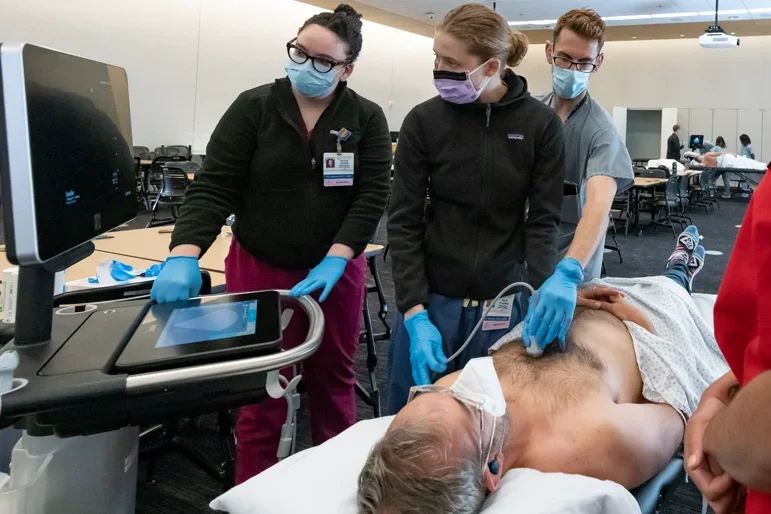
Our SPs are part of the UCLA family. As part-time UCLA employees, they come from all over Los Angeles and around the country to serve in many roles: as simulated patients, as live human bodies for ultrasound training, as actors for educational training videos, and as expert panel members to share real patient experiences. Many boast Hollywood credits or carry lead roles in theater; others are writers, teachers, and community advocates with full lives outside the role of an SP.
What SPs bring to a session is a unique craft: the specific cadence of a congestive heart failure patient describing their breathlessness, the closed-off body language of someone who doesn’t trust doctors, the quiet urgency of a person afraid of what they’re about to hear. They hold the scene together while a future physician or nurse works through a first history and physical. And when the session ends, they don’t disappear. They debrief and give feedback to the learners.
SPs are trained by SP Educators to give feedback in a standardized format. Before Sam Wilkes (a former SP Educator) introduced the HEROES debriefing technique at UCLA, SPs would stand in front of a small group and describe to everyone what a single student had just done, talking about the student in third person instead of directly to them. HEROES (Hello-Explore-Respond-Observations-Engage-Solutions) shifted that approach by allowing SPs and students to engage in a two-way conversation, so that SPs can provide authentic feedback, allow students to give their perspectives, and account for psychological safety. Questions like “How did that feel for you?” and “What were you working on today?” helped students reflect and explore for deeper learning. They augment the feedback that our faculty educators provide, by giving the patient perspective.
The UCLA pool of 120 SPs reflects as closely as possible the types of patients our trainees might see in LA County. Thanks to the efforts of Ken Lay, our SP Program Director, we are fortunate to recruit SPs with various backgrounds and ethnicities, including American Indian/Alaska Native, Asian American/Pacific Islander, Black/African American, Latine, and White. Spanning ages 18 to 80, they can play roles from teenagers to older patients. Approximately 37% can speak a language other than English.
While technology has introduced increasingly sophisticated manikins, AI-generated patients, and immersive virtual simulation environments, one lesson has remained true and unchanged: some of the most important skills in healthcare can only be learned through meaningful human interaction. Our SPs keep that human connection at the forefront. They bring realism, empathy, and lived experience into the learning environment, creating a safe space where healthcare professionals can practice, reflect, and grow before caring for real patients. They remind us that behind every symptom, diagnosis, and treatment plan is a person seeking to be seen, heard, and cared for.
We are truly grateful that for more than 30 years at UCLA, our talented SPs have helped generations of learners transform knowledge into human connection, ensuring that clinical competence develops alongside compassion. What began primarily as a teaching tool for medical students expanded over three decades into an interprofessional resource serving medicine, nursing, dentistry, public health, residents, fellows, practicing clinicians, and healthcare teams. Today, SPs support hundreds of educational activities each year at UCLA Health and our health sciences schools, helping learners practice everything from history taking and physical examination skills to delivering difficult news, navigating family dynamics, addressing health inequities, managing conflict, and strengthening compassionate communication.
Alongside our clinician-educators and the SP Educator staff who make the cases come to life, SPs help teach the skills that matter most, ensuring that when the curtain rises on real patient care, our learners are prepared not only to treat illness but to care for the person behind it.
To our UCLA SPs: Here’s to you! You make a difference in healthcare education. Thank you for the art and humanity that you bring to healing people!
Learn more about the SP Program.