From Volunteer to Medical Student
How Sloan Senofsky Found His Path at the UCLA Simulation Center
Sloan's Path to Medical School
Sloan Senofsky arrived at UCLA in the summer after his sophomore year at Pomona College with a simple request: any volunteer opportunity at all. He wasn’t picky. He had spent the previous nine months as his mother’s primary caretaker through her treatment for pancreatic cancer, and she had died at the beginning of that summer. He needed a reason to leave the house.
What UCLA had available was the Pre-Med Summer Scholar Program, a summer immersion for high school students run by the Center for Advanced Surgical and Interventional Technologies (CASIT) in partnership with the UCLA Health Volunteer Office, with collaboration from the UCLA Simulation Center. More than 200 high school students applied. Senofsky volunteered. He was the only non-UCLA member of the coordinating team, and he spent the two-week program arriving early to set up and making himself useful once the scholars arrived. Part of that usefulness meant lying still while they practiced ultrasound on his stomach.
Dr. James Wu, an endocrine surgeon working in medical education, came through the program that summer. Senofsky asked whether there was anything else he could help with.
“You never know until you ask,” he said.
There was. That question became a year spent on CASIT research that he carried alongside his coursework at Pomona, and it introduced him to a building full of people whose work he had never encountered before.
Among them was Nina Do, a simulation technician at the UCLA Simulation Center who had also volunteered in Pre-Med Summer Scholars. Senofsky wasn’t pursuing her job; he didn’t know what a sim tech was. He simply liked the sim tech team. When Nina left for physician assistant school and the position opened the spring he graduated, she encouraged him to apply. He was hired.
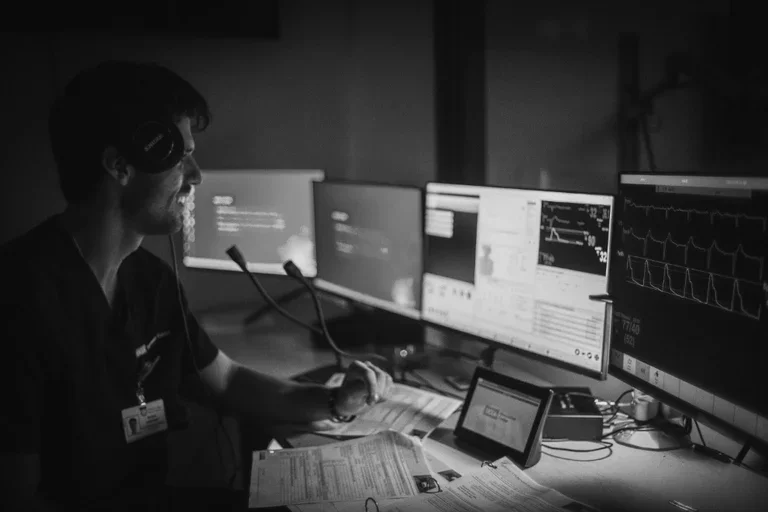
Within the year, he had become something of a fixture on Level A of Rosenfeld Hall, as the technician who ran 32 simulations in a single day, still the informal record among the team. Asked how he managed it, Senofsky credits four years of college football.
“Being confident that you’re prepared to handle whatever comes up lets everyone else take a load off,” he said. “I don’t want to be the limiting factor.”
Simulation is a team discipline. An instructor teaches, learners perform, and a technician keeps the scenario running: programming the manikin, managing the audiovisual feed, resetting the room between cases and staying half a step ahead of everyone in it. On a full day, that can mean dozens of resets, each one invisible if it goes correctly.
What makes Senofsky’s path notable is less where it ended than the order in which it happened. Most people don’t work alongside CASIT researchers and clinical educators until they are already well into medical training. Senofsky had all of it before an acceptance letter arrived.
By the time this story reaches you, he will have matriculated into the David Geffen School of Medicine at UCLA. He received his white coat on August 10, 2026.
Asked what he expects to miss, he doesn’t reach for the record day.
“Proximity to medical academia keeps you sharp,” he said. “These people are in settings where they have learners around them, and they have to be sharp on their material in order to teach others. It just makes them such better physicians.”
There's More Than One Way to Get There
Senofsky grew up understanding a single track into medicine: work hard, sacrifice, arrive. A year at the Simulation Center revised that.
“There isn’t one way to get there,” he said, when asked what he would take with him. He spent the year among instructors, technicians and physicians whose careers had all arrived at the same place from directions that looked nothing alike.
He points to Dr. Ed Lee, an internist at the West Los Angeles VA Medical Center who teaches, trains for marathons, is married to another physician and still makes it home to his children.
“It’s like you don’t have to let one thing dominate your life,” Senofsky said. “All those things really add to what makes him an awesome instructor. It doesn’t take away. It adds to who they are.”
That observation has already shaped his plans. Senofsky expects to stay close to academic medicine rather than move away from it, in part because he has watched what teaching does for the people who do it.
Twenty-Eight Hours in a Day
Asked to name one person who shaped how he sees the profession he is about to enter, Senofsky struggled to narrow it down.
“Every single one of the people I’ve worked with here has inspired me,” he said, working through names and trying to give each of them credit.
He eventually landed on Dr. Cecilia Canales, medical director of the UCLA Simulation Center, known as “Ceci” throughout the Center and well beyond it. Someone who, in his estimation, “somehow finds 28 hours in a day.”
He isn’t describing a person running on empty. What he and Canales keep arriving at, from opposite ends of the same road, is that no one placed either of them on it.
“No one is forcing us to go down this path. We do it because we love doing it,” he said. “Yes, it’s hard. But it’s the hard you sign up for. We feel very privileged to be in the spots that we’re in.”
It is a kind of gratitude that is easy to state and considerably harder to sustain once the work turns difficult. Senofsky already knows the difference.
Living the Dream
Ask Senofsky how his week is going, and there is a reasonable chance he will tell you he’s living the dream, sometimes sincerely, sometimes with the timing of someone twelve cases deep. Pressed for a concrete example, he offers one readily.
It begins with the morning brief. From there, he is beside an instructor for the first case of the day, coordinating a simulation scenario he helped bring to life and learning something about medicine he didn’t know that morning. Later he and fellow simulation technician Ina Farestad walk to Geffen Hall to set up another session, and somewhere along the way he gets an update on her daughter’s singing recital and the state of her avocado plants.
“The time flies when you do that,” he said, “and it makes such a big difference.”
It is an unremarkable description of a workday, which is roughly his point. Connecting with the people he works alongside is what makes the work rewarding, and it is also what makes it function: the Center depends on people who can hand a case off to one another without friction, and that reliability is built in the ordinary hours between sessions.
The Easy & Harder Version of the Story
Senofsky began medical school one week after his last day at the Center. Four years of school, then residency, then fellowship, with the goal of practicing medical oncology, pancreatic cancer specifically. By his own arithmetic, he will be fully trained at 34.
The motivation is not abstract to him. He sat beside a dying parent while the answers ran out, and he watched the UCLA Health team who cared for his mother do that work well. The compassion and dignity they showed is what he wants to pay forward.
“There’s going to come a time when someone else’s family member’s care is in my hands,” he said. “That’s the motivator for being as good as I can be. It’s not an ego thing.”
At the end of the interview, Senofsky offered a caution about his own story. “Grief turned into purpose is the easy version,” he said.
The harder version is that the loss does not resolve into a lesson. It doesn’t close, and it doesn’t trade evenly for a career. What changes is what he chooses to carry, and how he chooses to speak about it.
“Any chance I get to talk about my mom and the impact she made on me is a happy point,” he said. “It’s not a thing where I look back and think this is such a sore topic because she died. This woman made such an impact on my life. I am so grateful for the time I had with her. I wouldn’t trade it for anything.”
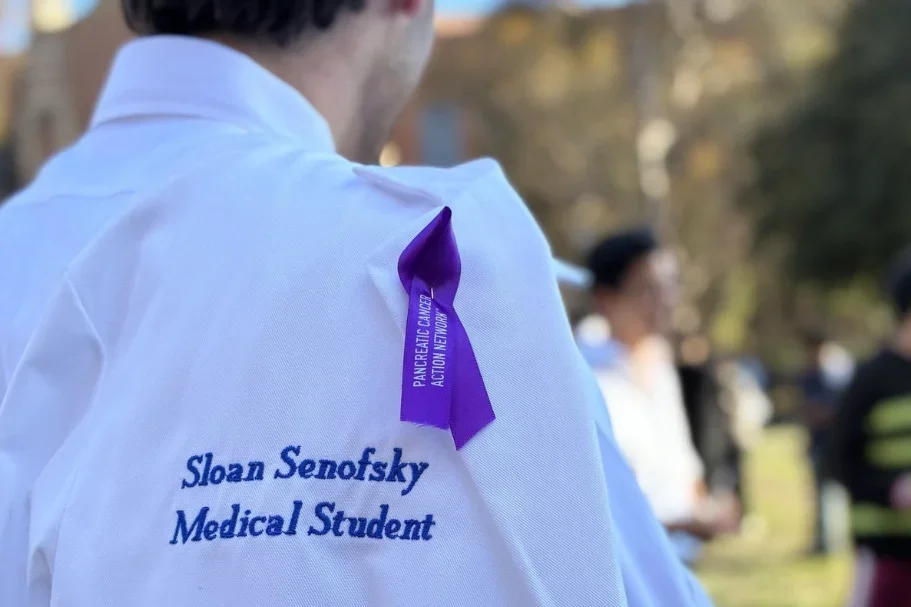
Several weeks later, he wore a purple ribbon to his White Coat Ceremony: the color designating pancreatic cancer awareness. A deliberate piece of his mother, carried into the first official day of the career she helped set in motion.